Thursday, April 20, 2017

Hripseme's Story - Never Forget

Wedding Photo taken in Turkey
 April 24 is the day Armenians remember the genocide that took place around 1915.  My mother wrote the following tribute to her mother for her 92nd birthday.

I will always remember my grandmother would cry and mutter things in Turkish. I would ask why grandma was crying and would be told in hushed voices that she is remembering the genocide.  Let us never forget and let us never be silenced.

The following is my mother's tribute -


            ....Born in Aintab, Turkey, in 1985 to Soghmon and Khanoom.  Her father was very well known to all the schools and townspeople as their baker of bread and Lahmajoon.  She was the only daughter.  Mom had four brothers.

            In 1914, she and my father, Armen, were united in marriage.  It was a big and fashionable wedding party that lasted for three days.

            Their first child was a beautiful, bright and healthy little girl who gave them much joy. She was not quite two years old when the Turkish government sent orders to have the Turkish army go around and evacuate everyone in Aintab from their homes.  They must leave!  Only whatever could be placed on a donkey’s back was allowed to be removed from our house.  That was it!  They were all ordered to go in the direction of the desert.  And march they did

            Her trousseau of finest lace, satin and silk was not meant to be enjoyed by her.  One by one, each article was sold for the price of something to eat.  Her gold coins, chains and rings also went the same way.  Eventually, hunger became unbearable and death took its grim toll.  One by one, God called their first born - then their second born - then their third born to be by HIS side.  They were never to feel hunger again.

            As time went on, Pop was able to trade some carpenter work for a sewing machine.  Mom learned how to use it and did dressmaking and alterations, mainly for the Arabs along the way.  They had a very dear companion whose name was Yepros Shirejian.  Yepros was good at scouting around for mom, to sew for the people.

            The Turkish government found out that Pop was a good carpenter.  They were in demand to help build army barracks.  He was taken away to the army.  His instructions were that he was not to reveal he was an Armenian or he would be killed immediately.

            At one point, a friend of his in the army came to him and said, “You know, the army has Armenian men working here and I overheard that the higher ranking officers give orders to kill them all, TOMORROW.”  Needless to say, Pop took his life into his hands and managed to escape during the night.  Being that he was on guard duty made his escape possible.
           
            Now that he was reunited with mom, the news came that “the war is over, return to your homes.”  Somehow they managed to return to Aintab in 1918. She was on one wagon returning to Aintab when another wagon carrying her father was spotted. She could hardly contain her emotions. They ran into each others’ arms.  Her father kissed her all over her face and her eyes and thanked God she was alive.  Her face became covered with his tears.  Tears of joy!  People became impatient and told them to get back on the wagon so they could continue their journey.

            By September 1919, God saw fit that I should be born there.  Armen and Horipsema (Helen) now had a fourth child.  Me!  Starting life all over again, with no money, yet with a stronger faith in God.  What would be my destiny?  Pop went to the American hospital where the Red Cross had canned milk for the patients.  Pop had made friends with Dr. Shepherd, an American Christian doctor.  He begged him for a prescription for some milk for me, or I too would die.  This helped for the time being.  But, again there was trouble. Disagreement was brewing between the Turkish government and the French, English and Germans.  The bombs started off again.  My father took us to the safety of a cave.  He was standing guard to see if it was safe enough to live - a bomb exploded and the shrapnel was embedded in his eyes and face.  He was taken to the American hospital.

            Again, they were ordered to leave Aintab.  By this time, families were terminated.  No matter who you talked to, somebody was killed or died of starvation or illness.  For those who left Aintab now, there was no donkey to carry the burden.  They walked and walked - heading south of the border.  Families became even more separated and confused.  They accepted wagon rides from anyone going south.  Pop had told Mom to find his sister, Mariam, who lived in Aleppo, Syria.  The wagon, Mom was on with baby brother and myself, continued on.  It was getting dusk.  The wagon went to the cemetery and dumped the people out.  This was as far as she would go.

            Fear gripped her heart, tired - hungry - lonely - two little ones - where to go from this cemetery - at night?  She had the sister-in-law’s address, but no one could tell her where it was.  After much walking, swollen feet, and complete exhaustion, she sat down for a goody cry.  Suddenly, she felt a gentle hand on her shoulder.  “Girl, what are you doing here?”  When she looked up, it was Mariam’s son.  He assisted her in taking her home where everyone greeted her with love and joy.  She was given both food and rest.  The next day Pop was at the door.  He had been put into the Turkish army again and kept having troubled dreams.  They kept telling him - “go, go, your son is dying.”  So, again he escaped from the Turkish army and found his way to his sister’s house in Syria.  They told him, “Horipsema is resting, Azadohi is also asleep, but your baby son died during the night.”  What a heartbreak!

Syria circa 1920 
            As time went on, things looked better.  Mom had another baby, there was no one home - no telephones to call anyone.  Pop did not know what to do. The baby died right after birth.  Another heartbreak.  My father vowed right then and there that if God would spare my life, he would make a journey to Jerusalem and place a lighted candle in my hand to say a prayer, and place it on a special container for all candles.

            Now his wife, my mom was expecting another child. That is my brother, George. Yes, faith can work miracles.  He lived and still is with us. Thank you God!

            Now they had two children to plan a future for.  What could be more important?  Pop heard that Italy was the place some people were going for relocation.  We went.  The government supplied a big public tent for the homeless Armenians. Why wasn’t I afraid of the mice and rats that were all over the place?  I’ll never know.  There was a huge area for public washing of laundry.  To walk there was slippery and dangerous.  Pop decided to try to go to France.

Hripseme, Azadohi and Armen
            We arrived in France just in time for another child to be born.  A little girl.  Pop left for another “better place.”  He had several brothers in Philadelphia.  Perhaps it would be better to move there.  Since my brother had a Jerusalem birthplace on his passport - it was not available for him to go with us.  So, Pop went alone.  But instead of a delay of four weeks - it was four years of waiting to come to America.  In the meantime, baby Marie became sick.  Mom took her to the hospital.

            The story here is a bit confusing.  They told her the baby was too sick and she must now take her home (that doesn’t sound like a hospital).  Mom had gone to get the child, while my brother and I were holding onto her skirt.  What really happened?  They told her something she could not understand.  They told her to go home.  To this day - I cannot accept anything that tells me she died.  I don’t feel it in my heart that she did.  I asked Mom if they allowed her to go see the baby, she said “NO.”  They were very rude to her.  Was this child given out for adoption?  I pray she was.  If so - she is alive.  Dear God - whether she is with you or whether she is being loved here on earth - watch over her!

Azadohi, Krikor & Hripseme in France 1925
Reunited in Philadelphia
 Finally, we came to America.  Mom and I came first; George followed us six months later, at the age of five.


Azad ©1982


PostScript:  My mother told me that she cried all the way on the boat to Ellis Island missing her brother.


Friday, March 31, 2017

Visit to Ararat-Eskijian Museum March 2017


With my daughter, Angelina
Recently I was finally able to visit a museum (Ararat-Eskijian Museum) in Southern California (Los Angeles County) where I have placed some of my families artifacts from the Armenian Genocide era (@1914-1926) and their journey out of Eastern Turkey and to the United States where they finally arrived in 1928.

I took my odar (non Armenian) husband, my daughter and her two daughters.

The day was exciting, emotional and very informative.  The director, Maggie Goschin, has spent many years collecting the artifacts and arranging events.  She, along with the Eskijian family, have done a monumental job.

Here are a few pictures and description of our day:

My granddaughters, Shay & Jodie
Let me just say that the ornamental gardens around the museum and the chapel were stunning.  Beautifully landscaped and so pleasant.

The statue in front of the museum depicts an Armenian mother saving her child during the genocide and is entitled:  "Mother Armenia Rising Out of the Ashes."  In fact, many Armenian mothers chose rather to throw themselves and/or their babies into the river rather than be captured and tortured by the marauding forces.

The "Orphan Dress"
We saw many artifacts from that time period. Including what the director called the "orphan dress."  A dress which belonged to an orphan who walked 75 miles to an orphanage run by Mennonites in Eastern Turkey during the 1909 massacre brought on by the Bloody Sultan where hundreds of thousands of Armenians were murdered.  The dress had been recently found by an Armenian filmmaker at a college in Indiana.  We were so fortunate to see the dress which is currently on loan to the museum.  Maggie informed us that the patches that covered some of  the dress were not for rips or to patch holes, but were pieces of fabric from loved ones who had died and had been attached to the dress.  At that point I could not hold back my tears. Knowing I had uncles and aunts who died in the desert of Deir ez-Zor in my grandmother's arms or still born while on the "death march" to some faraway location where the army had sent them. Knowing how much my grandmother suffered was hard to comprehend and so the tears came.

Related to that was the bones from the same desert that were being displayed in the chapel above the museum.

Bones from the desert of Deir ez-Zor

The chapel was a treasure for the eyes: with beautiful stained glass windows and many displays.


Coat of Arms from "Lesser Armenia" 

The Coat of Arms where my mother was born in Aintab is called "lesser Armenia" because it was located outside the highlands of Armenia.

We also saw an "Oud" which the curator explained, to my surprise, was not indigenous to Armenians.  It is believed to have originated in Persia 3,500 years ago and is also seen depicted in ancient Egyptian drawings.  My grandfather loved to play the Oud.  So when my mother at 9 years old crossed the Atlantic so that the family could be reunited with her father (who had come ahead 4 years earlier) in America in 1928, she brought an Oud with her for her father.  My son keeps this cherished item for our memories.
An "Oud"
My daughter stands by a replica of the Etchmiadzin Cathedral in Armenia - considered the oldest cathedral in the world.

Here is an article I found that the Huffington Post did on the museum - click here.

My daughter admires a candle lantern used as a lamp

It was an eventful day and even more poignant as this month of April all Armenians around the world will commensurate "Armenian Martyrs Day" and a Day of Remembrance for the Armenian population of today's Eastern Turkey that was eradicated from their ancestral homelands and scattered throughout the world

Sunday, February 5, 2017

Football Brings a Moment of Clarity

Today is Super Bowl Sunday, a veritable national pastime in this country.  I'm married to a football fanatic, it would be unheard of to not watch football.  You can win or lose, but it's still an exciting time.

Being that I am not like minded, I endure football as best I can.  I know names of players because my husband tells me since I am his captive audience.

 A few years ago I read the story of a football player in WWII and the Philippine death march.  I like to recount the story on Super Bow Sunday because it reminds me that people can find common ground no matter how vehemently one disagrees. Now in this tension charged climate we are in, it might be good to reflect on that.

The Story of Mario G. `Motts' Tonelli, 1916-2003: Former Football star who survived Bataan

In 1942, Tonelli was an Army sergeant, only 25 years old, battling the Japanese in a steaming Philippine jungle.

He tells the story:

“ We knew we couldn't win. We didn't have ammunition. The ammunition that we did have was old and there were duds.”

Only two grenades in 25 worked. Finally, 12,000 GIs gave up—the largest single surrender in American history. Men too weak to defend themselves were made to march 70 miles. It was a death march. Ten thousand American and Filipino soldiers would die.

“ You'd see them get shot. You'd see them get killed.”

On the first day, a Japanese guard demanded Motts' class ring.

“ And he kept pointing at it, and I said, ‘No, I'm not going to give it to you,’ and a couple of guys said, ‘Motts, give him the ring. He's going to kill you!’”

The Bataan Death March is not known for any act of kindness. But there was one, because of something that happened five years before, in Notre Dame Stadium.

Motts Tonelli was a fullback then with dazzling speed. Two minutes left in the game against Archrival University of Southern California, he ran 76 yards for a touchdown. It was a moment one USC student from Japan would never forget. Five years later, on that jungle path, the student, now a Japanese army officer recognized Tonelli.

“And he said, ‘Did one of my men take anything from you?’ And I said, ‘Yes, he did. It's in his pocket.’ And he said, ‘Is this it?’”

It was Tonelli's Notre Dame ring.

“I went to the University of Southern California,” the officer said. “I graduated the same year you did. In fact, I saw the game when you made that long run that beat us. You were a hell of a player.”

 “He gave me my ring back and wished me good luck,” Tonelli recalled many years later.
 “When you're talking about a war, you're talking about life.”

That extraordinary gift helped Motts do something most of his buddies did not, he survived the ordeal, with the ring and the memory of a single act of kindness. He still faced four years as a prisoner of war until the Japanese surrendered.

It was one moment where of all things, a football game brought two sworn enemies together.


Let’s not make football political.  It’s one of the few times people of different stripes get together and drink beer, talk players and referees and get off the grid, so to speak.

Monday, January 16, 2017

A Thank You to Dr. King

Me - 1969 graduation

Recently I was talking to my granddaughter about how school was going.  She told me she was working on an essay about Dr. Martin Luther King.  I told her maybe I could add something to her essay because when I was in school in the 60s it was the height of the civil rights movement. 

She perked up and became real interested. I guess she didn’t realize that grandma was that old.  She asked me if I marched with Dr. King. I chuckled and told her that where I grew up in Fresno we didn’t really have any marches.  Nor did we have the kind of problems they had in the south, such as forcing black people to sit in the back of the bus or drink at separate water fountains, yet we still had issues.

In Fresno at that time, I explained, the people of color lived on the other side of the tracks, literally.  They had their own part of town where the railroad marked their territory.  You would otherwise never see a black person living or participating in life anywhere else.  My father’s business, a box manufacturing plant, bordered that area and several of his employees were people of color.  In fact his foreman was black and his yard boss was Latino and was affectionately called poncho.  Everyone loved him and he loved everyone.  I never learned bigotry or racism in any form from my parents.

I still have the picture of my very white father attending the wedding of the foreman’s daughter.  My father seemed so happy and was smiling so big; the only white guy there.
My father - at the wedding of his foreman's daughter - 1950s

My granddaughter’s essay brought me back in memory to that time and place.  I told her that I may not have been involved in any marches, unless you count Berkeley – marching against the war - but I remember that time in America so vividly. It was exciting in many ways, there were the controversies and there were the victories.  Many things were changing.  We all followed Dr. King’s speeches and listened to every word. 

For me as a high school student, these changes affected my life.  I explained to my granddaughter how in high school where I lived in the north part of town, way far away from those railroad tracks, they bused in young people of color to attend classes with us at my school.

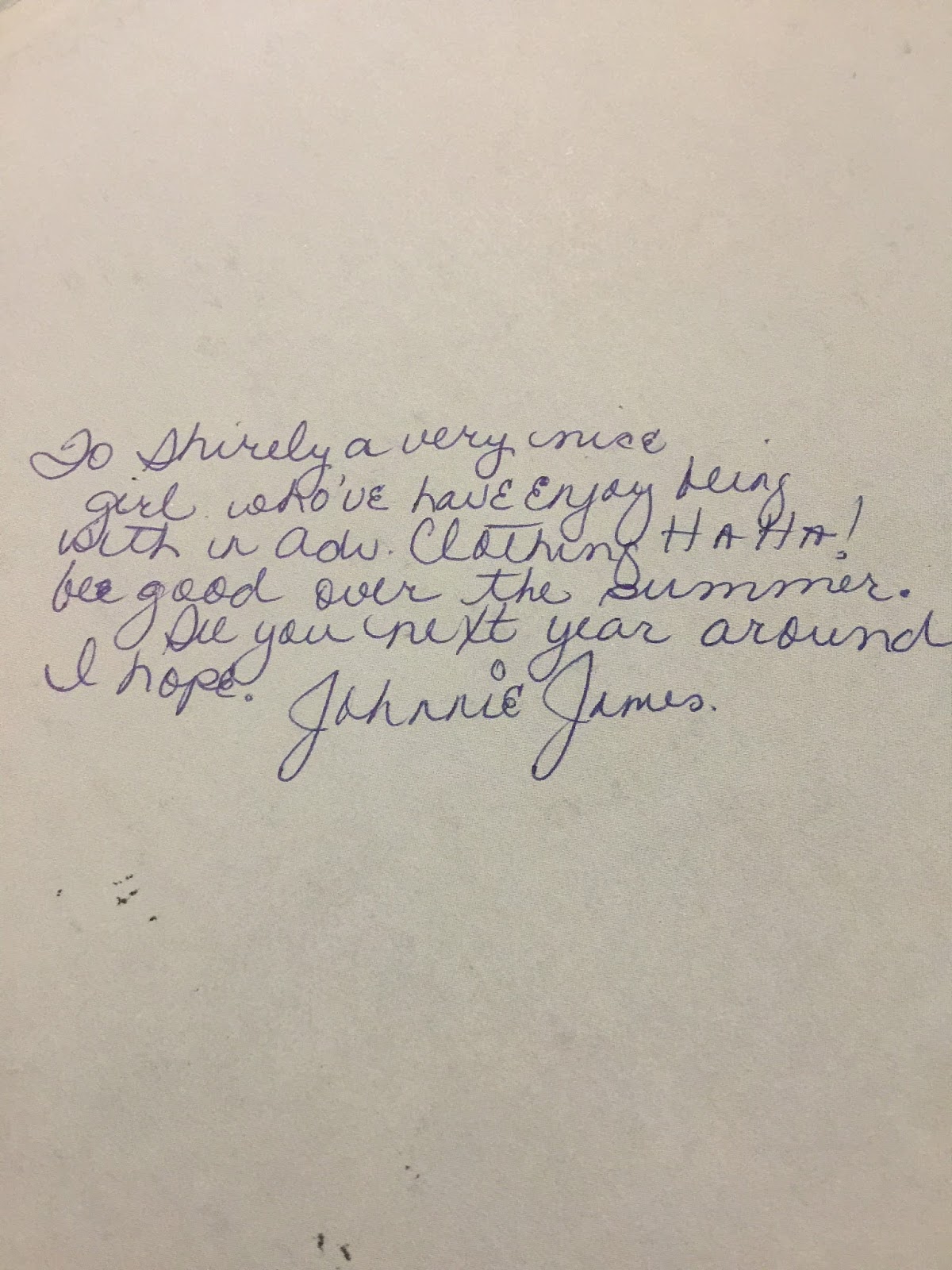
My memories are that all of us students welcomed our new fellow students with open arms. It was a happy time.  We were thrilled to be a part of these new changes. I don’t remember anyone being upset or critical in any way, shape or form.  We all wanted these changes to take place and for a people oppressed to feel welcome. I became good friends with one of the students in particular. I still remember her name, Johnnie James.

My granddaughter’s eyes were wide and she was so surprised that I experienced these things in my lifetime.  I found my old yearbook and showed her a picture of Johnnie and her sweet message to me which she read with enthusiasm.  We talked about other things in the yearbook, the times, the feelings, the experiences. 

As we parted and she clutched my yearbook, she said, “Grandma, may I borrow your yearbook for awhile?”  How could I say “no”?  I watched as she took my piece of history and carried it away next to her heart.


So today I want to thank Dr. King and his memory and the memories he made for me and that I was able to meet Johnnie and move forward in my generation and for future generations.  Let’s not forget his speeches that motivated us against hatred.

Update:  I am including a picture of Johnnie and her sweet comment to me in my yearbook.


Tuesday, December 20, 2016

One Christmas Story

Our blended family with other relatives

Since Christmas is only a few days away I've been reminiscing on the past and how our large family often suffered during those days.

My husband and I are a blended family and ended up with 11 children between us.  Some weren't always with us but at any given time we often had 8 children in our crowded home.  My husband had to return to college to study for a career to support all of us.  During this time we had very little money.

In spite of our lack of money, we always welcomed those around us who were in an even worse plight.  And for those who were lonely, which can be so devastating during such festive holidays, we gave them a special place at our table.

Most of the time we were able to have a nice Christmas due to the compassion of strangers and such organizations as the Salvation Army and our local schools and churches.

There was one Christmas, however, where nothing like that happened, my hubby was interning as a student teacher and had no income.  When Christmas came, we had very little in the way of presents.  We told the children we should just be happy with whatever God gave us and we should be thankful and think of all those who have even less.

About mid morning we saw a strange sight.  One of my daughter's friends had adopted us as her family.  Her father had been quite young when she was born and her mother had addiction problems.  She spent a lot of time at our home.  His name was Barry and we got to know him through his daughter.  Imagine our surprise when we saw him walking up our pathway with presents tucked under his arms.  He was a trucker and had just returned from the road.  At one of the truck stops he thought of us and bought presents for the kids,  We dubbed him our new Santa Claus.

What a great day that was.  Probably one of my happiest memories.  We spent the day eating turkey with Barry and watching the kids play with their new remote controlled cars out on the street.

I hope that all those who are lonely or needy this Christmas will find those who exhibit such a Christian message to give to those in need.  I pray no one feels alone. I know this is an impossible prayer, but even if a few more lives are touched, that would be the good news we all want to hear on Christmas.  Merry Christmas.

Thursday, November 24, 2016

Happy Thanksgiving 2016

Here's something I wrote about Armenians and holidays back in 2010:

While flipping through my families’ photo albums, I was struck with the enormous amount of pictures we have from our holiday gatherings.  Armenians are an emotional, gregarious race and nothing was spared for Thanksgiving and Christmas dinners.

The holidays were a time for our family to get together with all our relatives.  Not only were the meals huge and plentiful, but out came the best Armenian food ever.  We had cheese boreg with just the right amount of cheese, butter and a flaky crust – yum; green beans and lamb stew; yalanchi and sarma created with the loving and experienced skill of grandmas, aunties and cousins; Armenian string cheese; barstarma; and paklava for desert.

I swear my grandma made the best kufta and yoghurt soup ever.  Each kufta (a ball of cracked wheat and meat) was filled with pieces of nuts.  Out of the whole pot, there was one kufta that had a walnut in the middle.  Anyone who had that kufta in their bowl was the lucky one.  She also made choreg; a wonderful twisted, sometimes cheesy sometimes sweet bread.

My mother and grandmother cooked mostly with lamb. My grandmother owned a bakery and would personally go to the butcher and pick out the best lamb for her lahmajoon.  In those days there was always a butcher behind the counter at the supermarket and my grandmother and my mother would pick out the nicest piece of lamb and have the butcher grind it up for her.

Believe it or not but we ate a raw meat dish called khema (similar to steak tartare).   Well, that’s what we called it though I see on the net that other Armenians call it chee kufta or kebabs.  It’s in the shape of kebabs, but it’s raw so we called it khema and I loved it.  My mother made this so carefully with only the best ground lamb selected and carefully handled in order to be able to eat it raw.

It is on these memories that I say my Thanksgiving prayer for 2010.  Thank you God for all the blessings we have in our lives; that we can enjoy our meals freely without hindrance or strife; that our children can grow up educated, smart and pursue their talents and desires; that we can visit each other from across the country or across the world; that we can invite new friends and acquaintances to our tables and share with them in our abundance; that our ancestors can look down on us and smile because it is due to their sacrifice and stalwartness that we are able to enjoy these blessings. 


At the same time that I am rejoicing in my gratefulness, I am also sad hearted to think about the many people in our world who are not enjoying the same things.  Instead they are hurting and suffering great perils and strife.  I pray for those suffering in the world today.  

Tuesday, November 22, 2016